

What Is NMN Powder (β‑Nicotinamide Mononucleotide)?
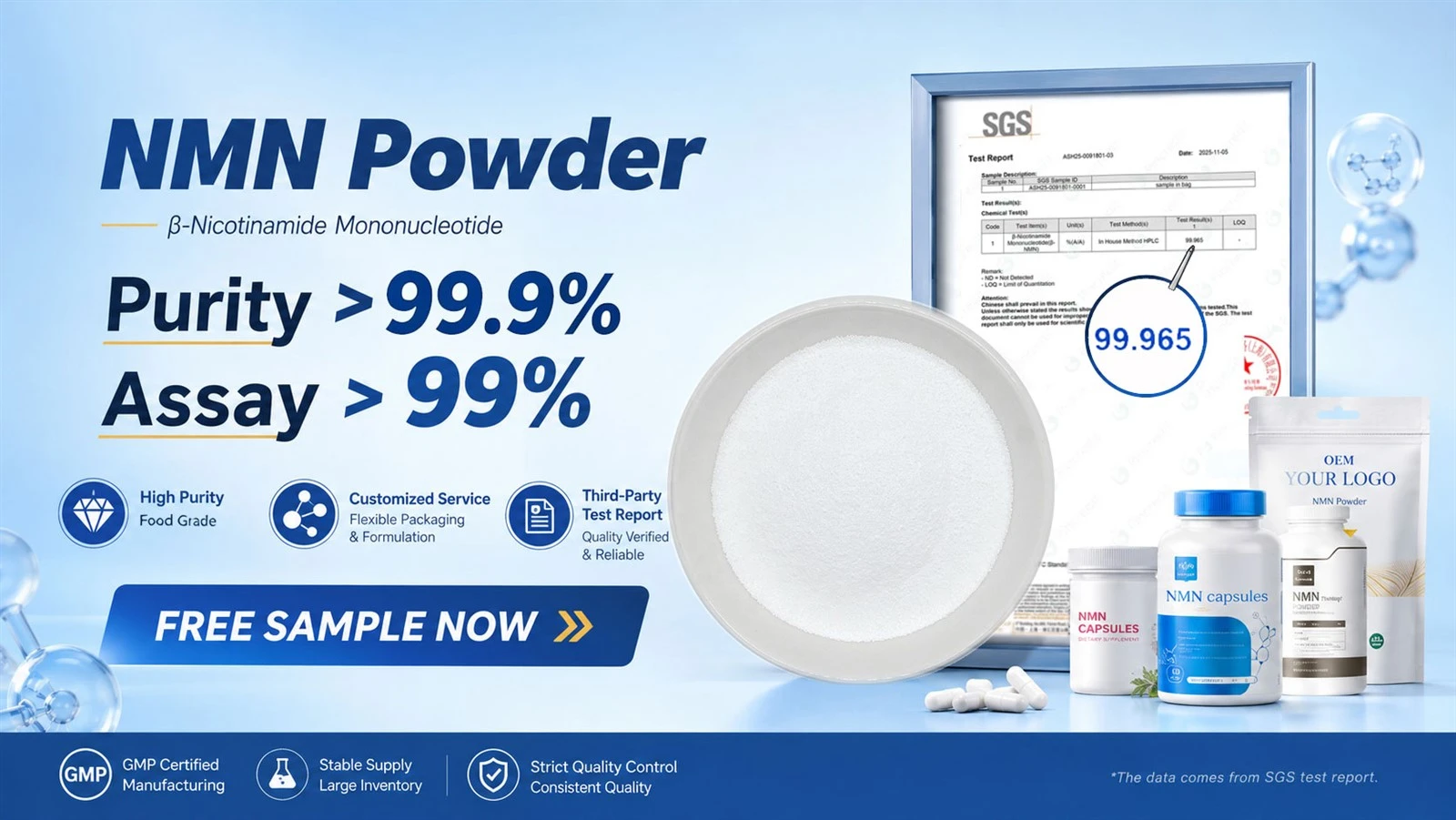
NMN powder, formally known as β‑Nicotinamide Mononucleotide, is a natural bioactive nucleotide classified under the vitamin B3 metabolic family. With the official CAS registry number 1094‑61‑7, it is one of the most popular core raw materials in the global dietary supplement industry. Unlike ordinary synthetic additives, β‑NMN refers exclusively to the biologically active beta‑anomer molecular structure, which is the only effective form for nutritional supplementation applications.
In its natural state, trace amounts of NMN exist in common foods like vegetables, fruits and meats. However, the content is extremely low, far from meeting daily nutritional supplementation needs. Therefore, modern commercial NMN powder is professionally synthesized and highly purified for industrial and commercial use, becoming the mainstream raw material for high‑end wellness supplements worldwide.
High‑quality pure NMN powder presents as fine, uniform white crystalline powder, odorless with a slight natural bitter taste. It features excellent water solubility, which enables easy absorption and flexible processing into various supplement finished products, making it highly adaptable for the dietary supplement manufacturing industry.
Complete NMN Powder Technical Specifications
Standardized parameter indicators are the core basis for judging NMN powder quality. Premium commercial food‑grade NMN powder undergoes strict HPLC high‑performance liquid chromatography testing and third‑party laboratory verification to ensure stable and reliable indicators. Below is the full official specification of high‑purity bulk NMN powder:
|
Specification Item |
Detailed Parameter |
|---|---|
|
Product Name |
NMN Powder / β‑Nicotinamide Mononucleotide |
|
CAS Number |
1094‑61‑7 |
|
Molecular Formula |
C₁₁H₁₅N₂O₈P |
|
Molecular Weight |
334.22 g/mol |
|
Appearance |
Fine white crystalline powder |
|
Purity |
>99.9% (SGS third‑party tested, actual test value 99.965%) |
|
Assay |
>99% (Tested by HPLC method) |
|
Product Grade |
Food Grade |
|
Manufacturing Standard |
GMP Certified |
|
Solubility |
Freely soluble in purified water |
|
pH Value (Aqueous Solution) |
2.5‑4.5 |
|
Shelf Life |
24 months (Sealed, cool and dry storage) |
Core Physical & Chemical Properties of NMN Powder
For supplement formulators, manufacturers and bulk raw material buyers, mastering the physical and chemical characteristics of NMN powder is crucial for production processing, finished product stability and long‑term inventory management.
NMN powder is an odorless crystalline substance with a slight bitter taste, featuring excellent water solubility and no insoluble impurities, which avoids precipitation and turbidity in liquid formula preparation. Its aqueous solution is weakly acidic, with a stable pH range of 2.0 to 4.0, compatible with most common supplement raw materials.
The most notable property of NMN powder is strong hygroscopicity. It is extremely sensitive to high temperature, high humidity and direct ultraviolet sunlight. When exposed to open air for a long time, it will quickly absorb water vapor, causing powder agglomeration, caking, and even gradual molecular degradation, which reduces active content and affects product quality. Therefore, sealed, moisture‑proof and light‑proof storage is a mandatory requirement for NMN raw materials.
Commercial Production Technologies of NMN Powder
At present, there are two mainstream industrial production processes for global commercial NMN powder, with obvious differences in purity, impurity content, safety and application scenarios, which directly determine the grade of finished raw materials.
1. Chemical Synthesis Process
This is a traditional mass production technology, which prepares NMN through multi‑step organic chemical reactions. It has the advantages of large output and low production cost, suitable for mass market low‑to‑medium grade raw materials. However, the process will produce trace chemical by‑products and residual solvents, requiring multiple professional purification procedures to meet food‑grade safety standards. The anomer purity of products produced by this process is relatively unstable.
2. Enzymatic Bio‑Synthesis Process
As the mainstream high‑end production technology in the market, enzymatic synthesis uses biological enzyme catalytic reactions to simulate natural synthetic pathways. This process has mild reaction conditions, no harmful chemical residues, and can accurately synthesize high‑purity active β‑anomer NMN. The finished powder has higher purity, fewer impurities and more stable quality, which is the preferred raw material for high‑end branded dietary supplements.
How to Identify High‑Quality NMN Powder (Professional Quality Judgment Standard)
Many buyers confuse "purity" and "assay" in NMN quality testing. In fact, these are two core independent indicators: purity represents the proportion of effective β‑NMN molecules in the total powder components, while assay is the effective active content detected by professional HPLC testing, which is the key data to measure actual efficacy.
The industry divides commercial NMN powder into two core grades: standard food‑grade and high‑purity premium grade. Standard food‑grade NMN requires purity ≥99.0% and assay ≥98.0%, which meets basic production requirements. Premium high‑purity NMN powder reaches 99.9%+ purity and 99%+ assay, and the third‑party SGS test data can reach up to 99.965%, with almost no invalid alpha‑anomer impurities.
In addition to core data, high‑quality food‑grade NMN powder must pass comprehensive safety testing, including heavy metal limit detection, microbial count detection, residual solvent screening and anomer ratio verification. Only third‑party independent laboratory test reports can provide objective and credible quality certification, which is far more authoritative than manufacturer self‑inspection reports. GMP standardized production workshops further ensure the hygiene safety and batch stability of raw materials.
Industrial Applications of Bulk NMN Powder
As a professional dietary supplement raw material, high‑purity NMN powder is widely used in the global health product manufacturing industry. Relying on its stable activity and good compatibility, it can be processed into a variety of finished product forms:
1. Solid Oral Supplements
It is the most mainstream application form, including NMN hard capsules and compressed tablets. Sealed capsule packaging can effectively isolate air and moisture, greatly slow down the degradation of NMN active ingredients, and ensure long‑term shelf life stability of finished products.
2. Portable Powder Supplements
Bulk NMN powder can be made into bottled finished powder or single‑dose independent sachet powder, which is easy to carry and take. In production, manufacturers will add a small amount of food‑grade anti‑caking excipients to solve the hygroscopic caking problem of pure NMN powder.
3. Compound Formula Supplements
NMN powder has strong formula compatibility, and can be compounded with resveratrol, PQQ, coenzyme Q10 and other high‑quality active ingredients to make multi‑effect compound health formulas, which is favored by high‑end supplement brands.
4. Private Label OEM/ODM Finished Products
As a universal base raw material, bulk NMN powder supports flexible customization of packaging, dosage and formula, helping brand owners launch exclusive private‑label NMN supplement products for retail, e‑commerce and offline wholesale channels.
Common Sourcing Challenges for Bulk NMN Powder
Professional supplement manufacturers and bulk buyers often encounter quality and stability problems when sourcing NMN raw materials.
First, inconsistent anomer purity. Many low‑cost NMN products on the market have high content of inactive alpha‑anomer impurities. Although the total purity data looks qualified, the actual active ingredients are insufficient, affecting the effect of finished products. It is necessary to ask suppliers for HPLC anomer identification test reports.
Second, transportation and storage deterioration. NMN powder is highly hygroscopic. Unsealed or non‑moisture‑proof packaging in long‑distance transportation will lead to powder moisture absorption, caking and activity decline, resulting in unqualified batch quality.
Third, unstable batch quality. Manufacturers without complete quality control systems often have large data fluctuations between different production batches, which brings uncontrollable risks to finished product production and quality inspection.
Fourth, lack of pre‑order verification channels. Formal and reliable raw material suppliers support free sample testing, allowing buyers to verify powder appearance, solubility and laboratory indicators in advance to avoid large‑batch loss risks.
Professional Storage & Handling Guidelines
The activity stability of NMN powder is highly dependent on storage conditions. Correct storage and handling methods can maximize the retention of raw material activity and extend the effective shelf life.
Bulk NMN powder must be stored in a cool, dry and well‑ventilated environment, with the storage temperature controlled below 25°C. It must be kept away from direct sunlight, high temperature heat sources and humid air. The original sealed packaging must be kept intact before use, and repeated opening and closing should be reduced. After opening the package, it is recommended to use it up quickly or re‑seal it with moisture‑proof equipment to prevent moisture absorption and deterioration. Under standard storage conditions, the quality of high‑purity NMN powder can remain stable for 24 months.
Frequently Asked Questions
What is the difference between NMN and β‑NMN powder?
β‑NMN specifically refers to the biologically active beta molecular configuration, which is the only effective form for nutritional supplementation. Ordinary NMN powder without beta marking may contain a large amount of inactive alpha‑anomer impurities, with low actual active content and poor use effect.
Why does NMN powder clump easily?
NMN powder has strong hygroscopicity, which will quickly absorb water vapor in the air when exposed to humid environment, resulting in powder agglomeration and caking. Sealed moisture‑proof storage is the key to prevent caking.
What test items should be checked for NMN powder COA?
The core inspection items include HPLC purity, assay value, beta‑anomer ratio, heavy metal content, microbial limit, residual solvent and batch production information. Third‑party SGS test reports have higher credibility than factory self‑inspection reports.
What is the best production process for NMN powder?
Enzymatic bio‑synthesis is the best production process for high‑end NMN powder, with pure active ingredients, no harmful residues and stable quality. Chemical synthesis is suitable for low‑cost mass production but requires strict purification.
How long does bulk NMN powder last?
Under standard sealed, cool and dry storage conditions, the shelf life of high‑purity NMN powder is 24 months. The activity will decrease rapidly after long‑term exposure to air and light.