

Capsanthin is a common pure natural pigment in life and production. Also known as capsanthin, it is a tetracool orange-red pigment found in mature red pepper fruits and belongs to the carotenoid pigment class. Capsanthin has bright color, high color value, strong tinting power, and good color retention. It is relatively simple to prepare and has stable properties, so it has a wide range of uses. It is not only widely used in the coloring of various foods such as aquatic products, meat, cakes, salads, canned food, beverages, etc., but can also effectively extend the shelf life of simulated food, and it is highly safe.
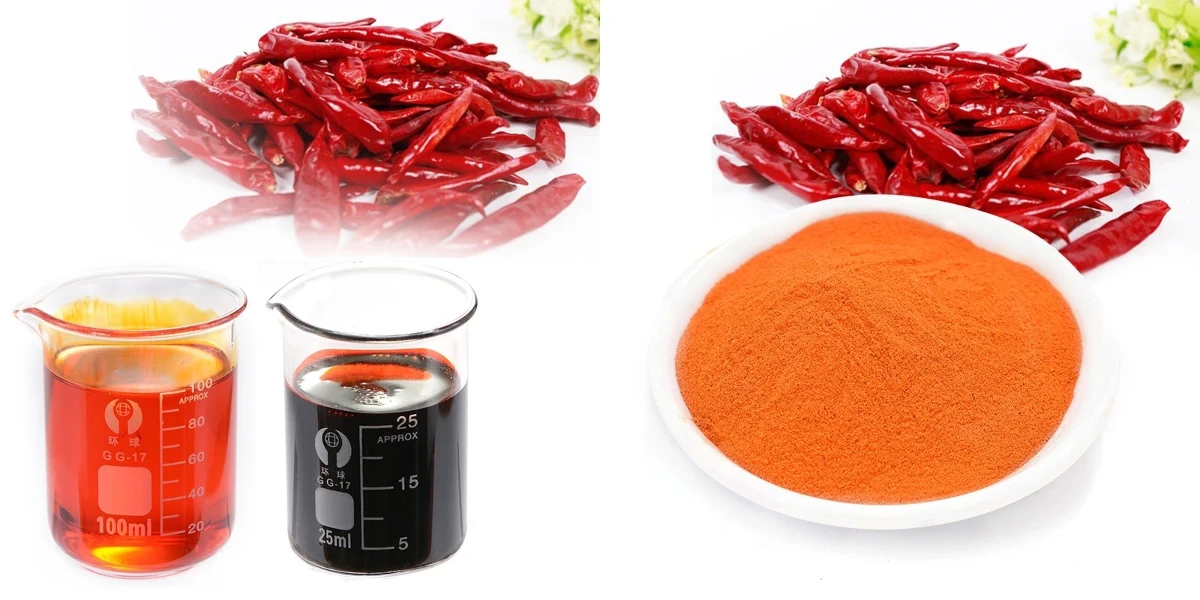
1. Source and properties of capsanthin
As the name implies, capsanthin is closely related to peppers. It is a pigment extracted from mature red peppers. Based on practical verification and component analysis, capsanthin is relatively stable, bright in color, and has good coloring properties. Most importantly, it is safe and non-toxic, and also has certain medical value. Therefore, capsanthin has become a pigment recognized by humans as relatively safe. WHO even lists capsanthin as a Class A pigment.
Capsanthin is an orange-yellow to orange-red natural red pigment obtained from the peel of red peppers of the Solanaceae family. It belongs to the oxygen-containing derivatives of lutein polyolefins. Its main components are capsanthin and capsorubin. Before being extracted, it is stored in the intact cell tissue of pepper fruits. Because it is protected by cell membranes and certain components in cells and forms lipids, when capsanthin is extracted, due to the loss of biological protection mechanisms such as cell membranes, capsanthin will undergo self-oxidation under aerobic conditions, and external factors will accelerate its oxidative decomposition and fade. The content of capsanthin and capsanthin in peppers varies depending on the pepper variety, origin, harvest period and drying conditions. Currently, most of the extracted capsanthin is a mixture of capsanthin and capsanthin. It is also widely used in industrial production and life in my country.
2. Composition of Capsanthin
The properties and usage characteristics of Capsanthin are inseparable from its composition. Capsanthin from peppers belongs to the carotenoid pigments. The composition of Capsanthin is relatively complex, and the main components are Capsanthin, Capsanthin, R-carotene, etc. Due to the differences in pepper varieties and pepper maturity, the content of Capsanthin in peppers is different, so the composition of Capsanthin also varies. The Capsanthin components contained in different pepper varieties are different. Generally, the quality of Capsanthin in peppers with good maturity is higher. In production, the peppers from which Capsanthin is extracted are all peppers with relatively high maturity.
3. Extraction of capsanthin
In the research and application of capsanthin, extraction has always been a very important link. From the current methods of extracting capsanthin, the common ones are solvent extraction, ultrasonic extraction, microwave-assisted extraction, supercritical fluid extraction, and enzyme extraction. Specifically, let's take the solvent extraction method. This method is a common method in the extraction of capsanthin. The principle of this method is to use the characteristics of capsanthin that can be dissolved in organic solvents. The specific extraction process is: the mature dry pepper is powdered, and then mixed with organic solvents such as ethanol and acetone to prepare capsanthin oleoresin, and then through a series of procedures such as distillation and separation, finally the capsanthin is obtained from it. The significant advantage of this method of extracting capsanthin is that the cost is not high and it can be implemented without expensive and sophisticated equipment. The disadvantage is that the purity of the extracted capsanthin is not ideal, and there are more organic reagents in the capsanthin. Therefore, this method is also showing a trend of being gradually eliminated.
Ultrasonic extraction. The principle of this method is to use ultrasound to crush the pepper more finely, so that the components of the pepper can be better integrated in the pepper red pigment extraction solvent, and finally obtain a higher purity of pepper red pigment. This method is similar to the solvent extraction method, but it has an additional pepper crushing step compared to the solvent extraction method. In general, this method is faster and more efficient, and the cost is not high. The most important thing is that it is a natural extraction method, so this method is more popular.
Microwave-assisted extraction method. This method uses microwaves to affect the pepper red pigment, so that the pepper red pigment is separated from the pepper components, thereby achieving the extraction effect. This method can ensure the purity of the pepper red pigment, is low-carbon and environmentally friendly, and has a relatively high extraction efficiency.
Supercritical fluid extraction method. This method is a new method that has only appeared in recent years. It uses pressure control and temperature control methods to enhance the solvent effect of C02 on peppers, and finally selectively extracts the pepper red pigment therein. This method seems complicated, but it does not have high requirements for the environment and operation. It can be implemented at room temperature. At the same time, there is no solvent residue in this method, and the extracted pepper red pigment has a high purity. It is also an ideal pepper red pigment extraction method at present.
Enzymatic extraction: This method uses cellulase, pectinase and other substances to change the cell walls of peppers, thereby extracting the red pigment of peppers.
4. Application of Capsanthin
The safety of natural pigment extracted from peppers has been recognized by the world. The United Nations Food and Agriculture Organization (FAO) and the World Health Organization (WHO) classify capsanthin as a Class A pigment, and there is no limit on its use. my country's Food Hygiene Law stipulates that capsanthin can be used in food processing such as oily foods, sauces, aquatic product processing, vegetable products, jelly, ice cream, cream, margarine, cheese, salad, sauce, rice products, baked foods, etc. It can also be widely used in feed, simulated food, radiation prevention, cosmetics and pharmaceutical industries. At present, Japan's annual demand for capsanthin is about 260 tons, with annual sales of about 2.3 billion yen: The annual sales of natural pigments including capsanthin in the United States have exceeded 200 million yuan: my country is not only a major producer of capsanthin raw materials, but also a major consumer of capsanthin. Therefore, the development and application of capsanthin has great economic benefits and broad market prospects.
4.1 Food industry Field
When Capsanthin is used in beverages, jellies, soy sauce, sugar and other foods, it is not only non-toxic and side-effective to the human body, but also can increase carotenoid compounds in the human body, and has certain nutritional value. The characteristics of Capsanthin are: uniform coloring, relatively stable properties, bright color, and broad application prospects in the food industry, especially in foods such as soy sauce. Therefore, the food industry production field has a strong dependence on Capsanthin. We can see the shadow of Capsanthin in the processing and production of condiments, oil products, beverages, cakes, meat products and other foods. Some scholars have studied the coloring effect of Capsanthin in food. The experimental results show that after the food is placed for 3 months, there is almost no floating stratification on the surface, and the soup of cooked fish is red. Both Japan and my country have developed pepper pigment preparations for beverages that have good stability, excellent coloring effect, easy manufacturing, and no additives.
4.2 Simulated Food Field
Capsanthin also has a great application in simulated food. Capsanthin is not only bright in color, high in color value, strong in coloring power, safe and non-toxic, but also has high stability, light resistance, heat resistance, acid and alkali resistance, and can effectively extend the shelf life of simulated food. Moreover, it has a wide range of sources and is an ideal natural food pigment in simulated food. In addition, the cost of capsanthin is relatively low, so capsanthin is widely used in simulated food. For example, capsanthin is used in the production of simulated bread, simulated fruit, simulated vegetables, etc.
4.3 Medical Field
Capsanthin has a wide range of uses in the medical field. Because capsanthin has a stable coloring effect and a certain drying effect, it is used in the sugar coating and capsule particles of medicines. Especially for children's medicines, the bright capsanthin can reduce children's fear of medicines and increase children's interest in taking them. In addition, in recent years, it has been found that R-carotene in capsanthin has a certain effect in treating arteriosclerosis. This discovery has further increased the application value of capsanthin in the medical field.
4.4 Animal Feed Field
Capsanthin is also indispensable in animal feed. There are two main reasons why capsanthin has a wide range of uses. First, capsanthin is a pure natural pigment, safe and stable in coloring. Second, animals cannot synthesize pigments by themselves, so feed becomes a necessary way for them to supplement pigments. Capsanthin can improve the skin coloring of pigs, cattle, sheep, fish, and shrimps, help them synthesize pigments, enhance the health of animals and improve their appearance. Therefore, capsanthin is favored in animal feed. At the same time, the effect of using capsanthin products in combination with lutein products is more obvious.
Capsanthin is one of the natural edible pigments with good safety, certain nutritional value and pharmacological effects. Capsanthin has a wide range of application value and is widely used in the fields of food industry, simulated food, medicine, radiation prevention, cosmetics, advanced feed, etc. It has good heat resistance, strong coloring, and natural, nutritious, functional and other characteristics. It has become one of the hot spots for development, research and consumption of food and food additives industries at home and abroad. Therefore, in industrial production and life, we must pay attention to capsanthin, deepen its research, and improve the application scope and application level of this pigment. my country has abundant pepper production and low price. The development and application of capsanthin has great economic benefits and broad market prospects at home and abroad.