

Sodium hyaluronate is regarded as the gold standard for moisturizing ingredients in skin care products. It leads the skin care market and becomes the benchmark ingredient most often mentioned and requested by consumers when talking about innovation, trends and efficacy. Sodium hyaluronate: It is actually the sodium salt form of hyaluronic acid. It is a high molecular linear mucopolysaccharide composed of repeated connection of N-acetylglucosamine and D-glucuronic acid disaccharide units. It is widely present in the extracellular matrix of connective tissues of animals and humans.

Its highly stretched and irregularly curled configuration in aqueous solution allows it to occupy a large area, and the molecular chains are intertwined to form a continuous network structure, making sodium hyaluronate like a "molecular sponge" that can absorb and retain water thousands of times its own weight. It is widely used in medicine, cosmetics, and health foods. After entering the human body, sodium hyaluronate can be hydrolyzed into hyaluronic acid, which has the effects of moisturizing, soothing, anti-inflammatory, repairing, increasing skin elasticity, and anti-wrinkle.
Hyaluronic Acid
Since hyaluronic acid carries negative ions and is hydrophilic, it can absorb a large amount of water. The gaps between collagen in the dermis mainly rely on hyaluronic acid to retain water. Its molecular structure can carry more than 500 times the amount of water. However, hyaluronic acid is a long-chain macromolecule that cannot penetrate the skin and reach the dermis, so it is impossible to remove wrinkles by applying hyaluronic acid. However, hyaluronic acid is a good moisturizing ingredient, which can reduce fine lines caused by dry skin.
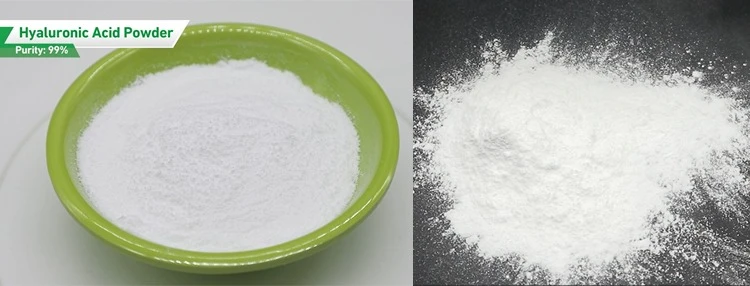
Hydrolyzed Hyaluronic Acid
Hydrolyzed hyaluronic acid is to decompose high molecular weight hyaluronic acid through enzymes to obtain hyaluronic acid with a smaller molecular weight to improve permeability. Unlike the average molecular weight of hyaluronic acid, which is between 500,000 and 2 million Daltons (Da), its molecular weight is generally within 10,000 Da.
Sodium Hyaluronate
Commonly used sodium hyaluronates are:
① Oligomeric sodium hyaluronate (molecular weight less than 10,000 Da);
② Small molecule sodium hyaluronate (molecular weight 10,000 Da-1,000,000 Da);
③ Medium molecule sodium hyaluronate (molecular weight 1,000,000 Da-1,800,000 Da);
④ Macromolecular sodium hyaluronate (molecular weight >1,800,000 Da);
The skin care function of sodium hyaluronate mainly depends on the molecular weight and dosage. Generally speaking, the larger the molecular weight of sodium hyaluronate, the greater the mutual entanglement between molecules, forming a wider molecular network, and forming a moisturizing and breathable film on the skin surface, making the skin moisturized and shiny, with the effects of nutrition, anti-wrinkle and skin rejuvenation.

Molecular weights above 2 million Da are generally used to store water, moisturize, and resist ultraviolet rays; 1.2 to 1.6 million Da is the most commonly used and cost-effective sodium hyaluronate; 200,000 to 400,000 Da is based on the conventional molecular weight. The molecular weight is reduced by enzymatic hydrolysis to increase its fluidity, allowing it to have a better moisturizing effect in the essence; the molecular weight within 10,000 Da can penetrate into the stratum corneum of the skin to achieve the function of deep hydration.