

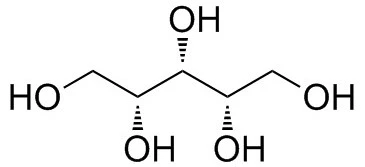
Image: Xylitol structure
Xylitol has a wide range of uses in many fields such as food, medicine, and chemical industry.
1. Application in the Food Industry:
Since the metabolism of xylitol in the body has nothing to do with insulin, it is used in the production of food for diabetic patients. Xylitol has a cool feeling in the mouth, and it is not fermented by bacteria to produce lactic acid in the mouth. It is a bad culture medium for microorganisms, so it does not cause tooth decay and can be used to make chewing gum. Xylitol has unique advantages as a sugar substitute. Xylitol will not undergo the "Maillard" browning reaction due to heating during food processing. This is because xylitol is different from sugars and has no aldehyde group. It will not react with amino acids to deepen the color of food. Xylitol is not affected by yeast and bacteria, does not mold, and can extend the shelf life of food. Therefore, xylitol is widely used in chewing gum, chocolate, beverages, candy and other products.
1) Application in chewing gum:
The sweetness of xylitol is the same as that of sucrose, and it can prevent tooth decay. The sugar-free chewing gum that is popular in the world now is produced by using sugar alcohols such as xylitol to replace sucrose.
2) Application in chocolate products:
Xylitol can replace sucrose in chocolate products. The raw material xylitol must be finely ground powder. This kind of chocolate with xylitol instead of sucrose is suitable for diabetic patients.
3) Application in beverage products:
In vitamin beverages made with xylitol, maltitol, sugar and fructose as compound sweeteners, xylitol mainly improves the sweetness of the beverage and gives it a refreshing feeling, and maltose gives the beverage a texture. The use of xylitol in beverage products controls the calorie value and stabilizes the efficacy of vitamins.
4) Application in edible soft candy:
Sodium cyclamate and xylitol are used as sweeteners to replace sucrose to produce dietary fiber soft candy. Dietary fiber soft candy uses chitosan and konjac powder as dietary fiber raw materials, sodium cyclamate and xylitol as sweeteners, and is developed using a certain process. It has good flavor and natural color, complete block shape, full body, delicate texture, and sweet and sour taste.
2. Application in the Pharmaceutical Industry:
Xylitol can reduce transaminase and is a good drug for treating diabetes and protecting the liver. It can supplement calories, improve sugar metabolism, not increase sugar load, and eliminate ketoacidosis. Xylitol not only does not pass through insulin in the human body's metabolism, but also promotes the secretion of insulin, so xylitol is a good nutrient and auxiliary treatment for diabetics. It can increase the physical strength of diabetic patients, reduce hunger and symptoms such as polydipsia, polyphagia, and polyuria, and reduce the dosage of insulin and other hypoglycemic drugs. At the same time, it also has the effect of inhibiting oral bacteria and preventing tooth acid erosion, and is used in the pharmaceutical industry to manufacture various drugs.
In addition, it can increase glycogen in the liver, reduce transaminase, improve liver function, and protect the liver. Xylitol has a strong anti-ketone body effect. Intravenous injection of xylitol has a good effect on rescuing patients with ketone bodies, and it is a calorie supplement for these patients. Xylitol can inhibit the growth of human fat, so long-term use of xylitol can have a weight loss effect. Adding xylitol to surgical anesthetics can play a role that glucose cannot. Xylitol has many other application values in the medical field that need further research.
3. Application in the Chemical Industry:
Xylitol can be used to produce surfactants with antibacterial properties; in the synthetic resin industry, it is used to produce a variety of alkyd resins; in the leather tanning industry, xylitol reacts with phenol, formaldehyde, phosphoric acid, etc. to produce colorless leather tanning agents, which have good water solubility and tannability, and are stable in storage and will not oxidize and darken, and are used to tan white leather.
Xylitol can replace glycerol and is used in papermaking, daily chemical products and the defense industry to produce explosive materials through nitration; it can react with synthetic fatty acids to produce non-volatile plasticizers; xylitol itself also has emulsification, dispersion, defoaming and other functions; it has better heat resistance and corrosion resistance than hexyl alcohol, and is an important emulsifier with good application prospects. With the expansion of xylitol's industrial application field and the development of production, the demand for xylitol will increase significantly.
1) Application in the plastics industry:
Xylitol and fatty acids with 5 to 9 carbon atoms can be esterified to produce heat-resistant plasticizers. The product has a high content of triesters and good compatibility. It can be used in soles, agricultural films, artificial leather and cable materials. Polyether resin is a new type of high molecular polymer. It is the main raw material for foam plastics, rubber, adhesives, etc. Xylitol can be used as a starter to make polyether, which is the basic raw material for further synthesis of rigid foam plastics. Xylitol can be used as an additive for polyvinyl chloride cables to improve insulation performance.
2) Application in paint and coating industry:
Alkyd resin is an important raw material for synthetic paints with good performance, wide application, low price. However, the preparation of this raw material consumes a lot of glycerol and edible oil. Using the characteristics of xylitol with five hydroxyl groups, it can save a lot of glycerol and edible oil as a substitute. Xylitol and tar oil can produce better dark paints.
3) Application in surfactants:
Surfactants are an emerging industry with a large amount of use. They are important chemical additives in chemical, petroleum, light industry, food, medicine, textile and other departments. It plays an important role in promoting reactions, improving performance and improving quality. The main synthetic raw material of sorbitol fatty acid esters in polyol nonionic surfactants is sorbitol. Xylitol and sorbitol are both polyols with extremely similar physical and chemical properties. Therefore, xylitol can also generate the above substances like sorbitol, and has the same compound properties as sorbitol, and is also a nonionic surfactant.
4) Application in toothpaste:
Currently, xylitol is widely used in chewing gum, and the technology is relatively mature. By chewing gum, it can effectively prevent tooth decay.